28 May 2026 · FurEver Yours
How your dog actually sees, smells, hears, and feels the world
Dogs don't experience the world the way you do. Vision, smell, hearing, touch — every sense is calibrated differently. A grounded look at the science.
Your dog isn’t seeing what you’re seeing. Not even close.
Most of us assume our dogs experience the world more or less the way we do — same colours, same smells, same sounds, just a bit lower to the ground. They don’t. Vision, smell, hearing, touch — every sense is calibrated differently, and once you know how, a lot of dog behaviour suddenly makes sense.
Here’s what the science actually says.
1. Vision — what your dog actually sees
Dogs aren’t colour-blind. The “dogs only see in black and white” line is folklore. The truth is more interesting:
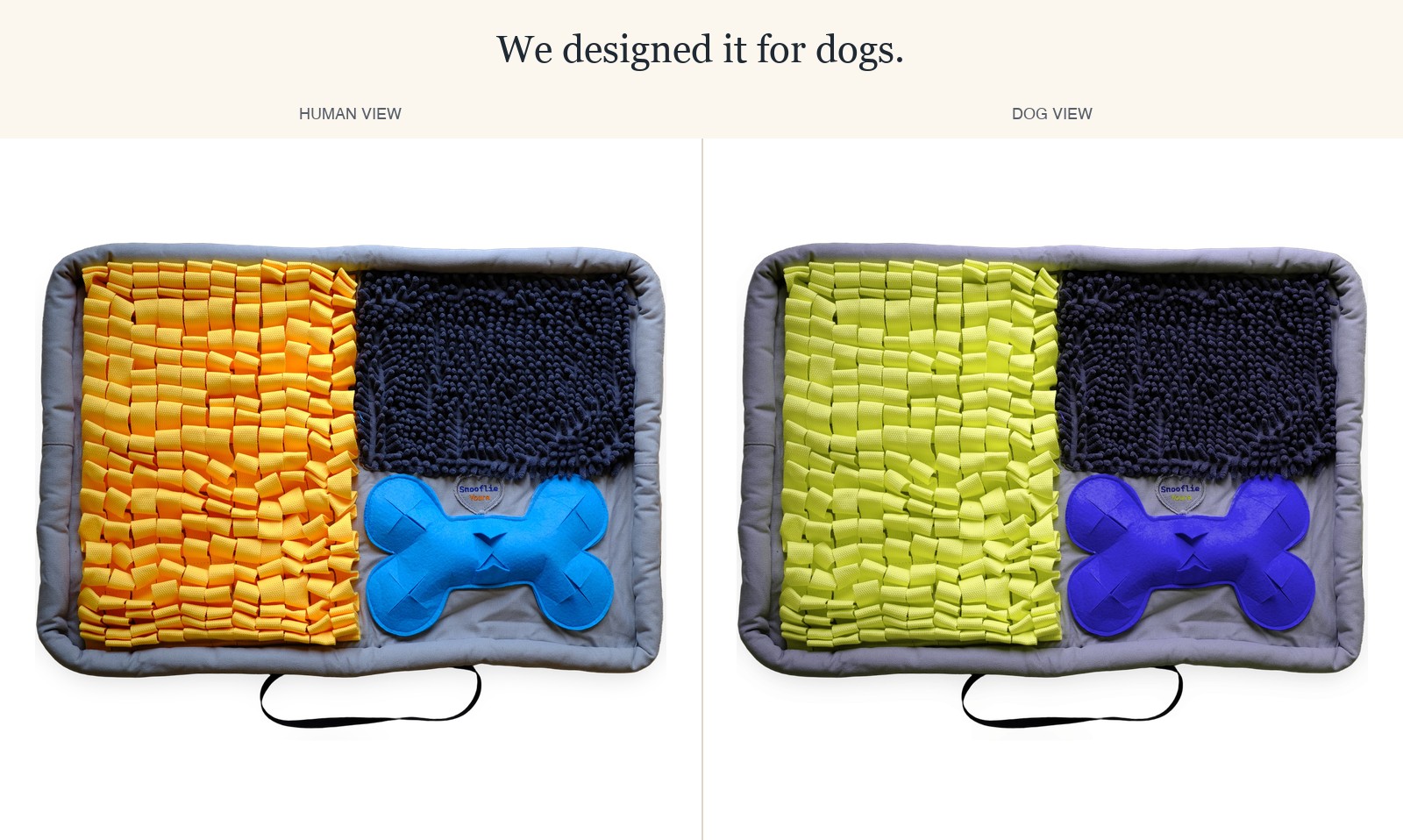
Dogs are dichromats. They have two types of cone cells — one tuned to about 430 nm (blue) and one to about 555 nm (yellow-green). We humans have three: blue, green, and red. The missing third cone means a dog can’t distinguish red from green; both collapse into a muddy brown or olive. Blues and yellows stay vivid for them. Some research suggests their blue perception is actually sharper than ours.
In other words: a garden full of red roses and pink petunias is, to a dog, a garden of muted greys and yellow-browns. The bright yellow daffodil next to it pops just as hard as it does for you. The blue sky overhead reads the same in both worlds.
This is also why we chose blue and yellow for our mats. Not as a style choice. Those are the two colours dogs see best, and a snuffle mat full of rainbow colours reads as a muddy mess to the only set of eyes that actually has to use it.
Below: the same idea applied to a garden. Left, as you see it. Right, as your dog sees it. Watch the pink petunias collapse, the yellow daisies stay bright, and the red brick wall turn olive.
2. Smell — an order of magnitude apart
Vision is a tiny corner of how your dog actually knows what’s happening. Smell is the main event, and the gap between human and canine olfaction isn’t a percentage difference — it’s an **order of magnitude**.
Humans have around 5 million olfactory receptors. Dogs have 220 to 300 million, depending on breed. The part of their brain dedicated to processing smell is roughly 40 times larger than ours by proportion.
Think of it like two bookcases.


When your dog sniffs the kitchen counter, they’re not “smelling food.” They’re reading a library — what was placed there, how long ago, whether it was warm, whether your hand touched it before. They breathe asymmetrically through each nostril to triangulate the direction of a scent. They have a dedicated organ (the vomeronasal, or Jacobson’s organ) for detecting chemical signals invisible to us.
A ten-minute sniff session isn’t a stroll. It’s a **mentally exhausting cognitive task**, equivalent in fatigue to a long walk. This is why a forage-based enrichment activity calms a hyped dog faster than another lap of the park.
3. Hearing — into the ultrasonic
Hearing tells a similar story. Humans hear roughly 20 Hz to 20 kHz. Dogs hear 40 Hz to about 60 kHz — they trade a bit of bass response for a vast extension into the ultrasonic range.
That 40-kHz–60-kHz zone above the dashed line is the dog whistle range, the chittering of distressed rodents in your wall, the high-pitched whine your microwave makes that you’ve never noticed. Your dog has been hearing that microwave for years.
They also have 18 muscles controlling each ear, which they use to rotate them independently and triangulate a sound source faster than your eyes can find it. This is why your dog seems to be looking at the right spot a beat before you’ve registered the noise.
4. Touch — what their skin already knows
Touch is the most under-explored of the four. Most owners don’t realise how much information a dog reads through the surface of their body.
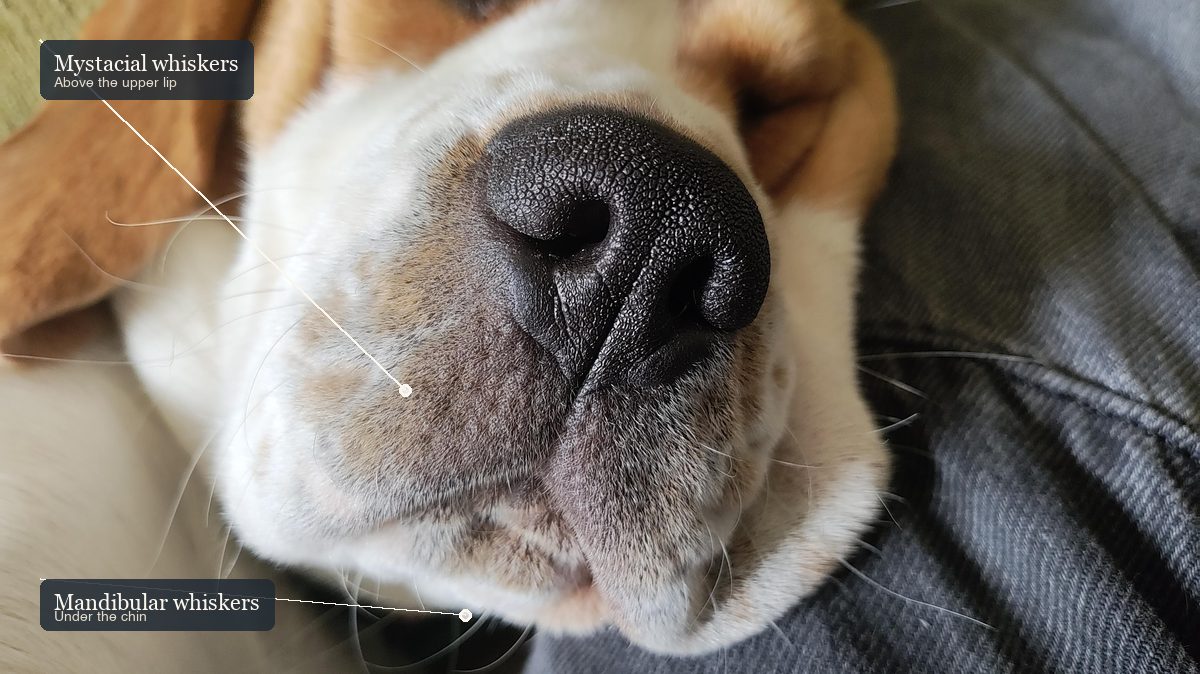
Dogs have four distinct whisker groups: the mystacial (above the lip), the mandibular (under the chin), the supraorbital (above the eyes), and the genal (on the cheeks). Each whisker sits in a follicle wired directly to a dedicated region of the brain. Brushing a whisker against something registers like running your fingertip across braille.
Paw pads detect temperature changes as small as 0.5 °C — more sensitive than the human hand. Dogs feel hot pavement before you’d notice it’s warm, which is why a quick paw-down test on summer ground is a sensible habit before any walk.
And every hair across their body sits in a follicle with a mechanoreceptor. A dog feels a fly land on their back before they see it move.
What this means for you
If you take only one thing from all of this: **the sniff matters more than the mileage**.
A dog walked briskly past every interesting smell for forty minutes is still under-stimulated. A dog given ten minutes to forage properly through a textured mat full of hidden treats is more tired — because the cognitive demand of decoding hundreds of layered scents activates the same brain regions a long, varied walk would.
This is why a snuffle mat works. Not because it slows feeding. Not because it occupies them. Because it gives a dog a job to do that matches the sense their evolution wired most heavily.